
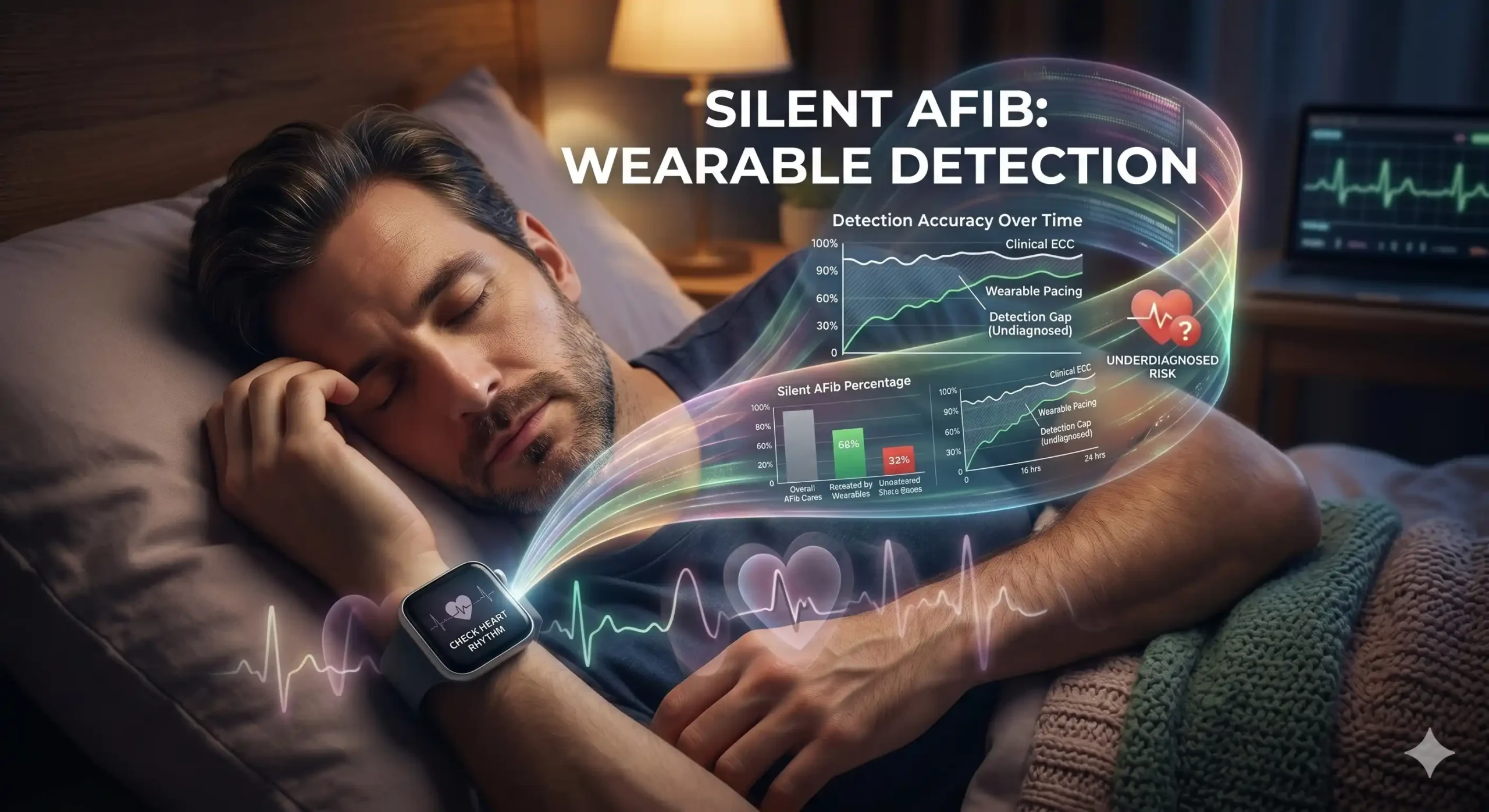
Silent AFib Wearable Detection: How to Use What’s Already on Your Wrist
You feel fine. No fluttering in your chest, no shortness of breath, no dizziness. So your heart must be fine, right?
Not necessarily.
Atrial fibrillation — the most common serious heart rhythm problem — can be completely silent. No warning signs. No symptoms. Just a heart quietly misfiring while the rest of you goes about your day. And in that silence, blood clots can form, travel to your brain, and cause a stroke.
Here’s the part most people don’t know: the device on your wrist may already be capable of catching it.
This article is for people already wearing a smartwatch or fitness tracker who want to know what it can — and can’t — tell them about their heart rhythm. No hype. No fear-mongering. Just what the research shows, and what to actually do with it.
What Is Silent AFib — And Why Does It Matter?
Atrial fibrillation (AFib) is when the upper chambers of your heart beat chaotically instead of in a steady, coordinated rhythm. In most people, this triggers noticeable symptoms: palpitations, fatigue, breathlessness.
But in a significant number of people, it causes nothing at all.
Silent AFib — also called asymptomatic AFib or subclinical AFib (SCAF) — is exactly what it sounds like. You feel completely normal. Meanwhile, that erratic rhythm creates conditions for blood to pool and clot inside the heart’s upper chambers. If a clot breaks free and reaches your brain, the result is a stroke. No warning. No buildup.
The numbers are stark. People with AFib have roughly five times the stroke risk of the general population, and AFib-related strokes tend to be more severe and more likely to be fatal than strokes from other causes.1
And silent AFib isn’t rare. Research using implanted cardiac monitors found it in roughly 1 in 10 asymptomatic individuals within three months of long-term monitoring — people who had no idea anything was wrong.2
The problem has always been detection. You can’t feel it coming. That’s the whole problem — and it’s why what’s on your wrist actually matters here.
What Your Wearable Is Actually Doing
Most people wear their smartwatch barely noticing the heart monitoring features. They check steps, sleep, and the occasional notification. But the device is doing something more interesting in the background — and most people have never turned it on properly.
Consumer wearables use two main technologies to monitor heart rhythm:
Photoplethysmography (PPG) — the optical sensor on the back of the device that shines light through your skin to detect blood flow changes with each heartbeat. It runs passively throughout the day, scanning for irregular patterns.
Single-lead ECG — available on many current-generation smartwatches and dedicated ECG monitors. You place a finger on the sensor, hold still for 30 seconds, and the device records your heart’s electrical signals and checks them for signs of AFib.
Both technologies have been validated in peer-reviewed research. A 2024 meta-analysis found that PPG-based smartwatches detected AFib with approximately 97.4% sensitivity and 96.6% specificity. ECG patch monitors came in similarly, at around 96.1% sensitivity and 97.5% specificity.3
For a consumer device you bought at a mall, that’s genuinely impressive. These aren’t toys.
The Real-World Catch: What Wearables Can Miss
Those accuracy numbers come with fine print worth reading.
Wearables typically can’t monitor continuously. Most devices only analyze your heart rhythm when you’re still — during sleep, or when you deliberately take an ECG reading. AFib that happens during movement, or in brief bursts between monitoring windows, can slip through undetected.
Short AFib episodes are a particular blind spot. Research on continuous long-term monitoring shows that very short paroxysmal AFib episodes — lasting less than an hour — are significantly harder to capture with intermittent consumer devices.4 This is probably the biggest gap most people don’t know about.
False positives happen. A smartwatch notification is not a diagnosis. It’s a flag — a signal that something needs checking. One study that followed up on irregular rhythm notifications found that only about one in three people who received an alert and wore a follow-up ECG patch were actually confirmed to have AFib.5 The other two-thirds had false alarms, usually from rhythm variations or motion artifact.
So no — don’t panic if you get an alert. But don’t quietly delete the notification either.
How to Get More From Your Wearable Right Now
If you have a device with heart rhythm monitoring, here’s how to use it properly — not just passively hope it catches something.
1. Enable the AFib and irregular rhythm notifications. Most devices have these turned off by default or buried three menus deep. Open your wearable’s companion app, find the heart health section, and switch them on. Some devices also offer an “AFib history” feature — a weekly estimate of time spent in AFib. If you’ve already been diagnosed, that feature is worth its weight in gold.
2. Wear it to sleep. This is where passive monitoring works best. You’re still, the signal is clean, and the algorithm has hours to work with. If your watch has been sitting on the nightstand overnight, that’s most of your monitoring window — gone.
3. Take active ECG readings regularly if you’re at risk. If you’re over 65, have high blood pressure, diabetes, obesity, sleep apnea, or a family history of AFib, take a quick 30-second ECG reading a few times per week. Don’t wait until something feels off. Silent AFib, by definition, gives you nothing to feel.
4. Save your readings. Most devices let you export or print ECG traces. Do it. One cardiologist described patients’ watch recordings as often good enough to confirm a diagnosis at the very first appointment — no extra testing needed.6 That’s hours saved, and potentially weeks off a diagnosis timeline.
5. Track patterns, not single readings. One abnormal reading isn’t that meaningful in isolation. A pattern of irregular readings over weeks? That’s a different conversation with your doctor entirely. Think of your watch less as an alarm system and more as a rhythm journal.
What Happens If Your Watch Flags Something
This is the step most articles skip. You got a notification. Now what?
Step 1: Don’t rush to the emergency room. A wearable AFib alert is not a cardiac emergency. AFib is serious and needs evaluation — but it’s not a “call 911” situation unless you’re also experiencing chest pain, sudden severe dizziness, or stroke symptoms (face drooping, arm weakness, slurred speech). Those warrant emergency care. A lone rhythm notification does not.
Step 2: Call your doctor within a few days. Let your primary care physician or cardiologist know your wearable flagged a possible irregular rhythm. Bring the device. Most doctors can pull up your saved ECG traces directly, or request a data export.
Step 3: Expect a confirmatory ECG. A standard 12-lead in-office ECG is typically the next step. If your AFib is paroxysmal — meaning it comes and goes — it may not show on the day you come in. In that case, your doctor will likely order a wearable ECG patch to monitor your rhythm continuously for 7–14 days.
Step 4: Understand that a confirmed diagnosis changes things significantly. Once AFib is confirmed, your doctor will assess your stroke risk and discuss whether blood-thinning medication is appropriate. It’s a real conversation with real stakes. And the reason it’s happening at all — instead of after a stroke — may be that notification you almost dismissed.
Who Benefits Most From Wearable AFib Monitoring
Wearable detection is most valuable for people who:
- Are 55 or older (AFib prevalence rises sharply with age)
- Have high blood pressure, diabetes, or heart failure
- Have sleep apnea (strongly linked to AFib)
- Are overweight
- Have a family history of AFib or stroke
- Have previously been told their heart rhythm “looked a little irregular”
If you check two or more of these boxes and currently wear a device with rhythm monitoring, turning those features on is worth doing today. Not eventually. Today.
The Bottom Line
Your wearable is not a doctor. It doesn’t diagnose. It doesn’t treat. But in the specific case of silent AFib — a condition that gives you no warning and raises your stroke risk fivefold — it can be the first and only thing that notices something is wrong.
The research is clear: modern wearables detect AFib with high accuracy. What they can’t do is act on what they find. That part is still your job.
Turn on the notifications. Wear it to sleep. If something flags, call your doctor. Three steps. Takes about four minutes to set up. That’s a reasonable trade for a potential stroke you never saw coming.
→ Want to understand the full landscape of AI tools for heart health? Read our guide: AI Tools for Heart Health: A Patient’s Guide
Frequently Asked Questions
Q: Can a wearable detect silent AFib?
A: Yes. Modern smartwatches and ECG patch monitors can detect atrial fibrillation even when you have no symptoms. A 2024 meta-analysis found PPG-based smartwatches detected AFib with approximately 97.4% sensitivity. However, they alert you to a possible irregular rhythm – only a doctor can formally diagnose AFib.
Q: What is silent AFib?
A: Silent AFib (also called asymptomatic or subclinical AFib) is atrial fibrillation with no noticeable symptoms — no palpitations, no dizziness, no shortness of breath. You can have it without knowing it. It still raises your stroke risk five times compared to people without AFib.
Q: What should I do if my wearable alerts me to possible AFib?
A: Don’t panic, but don’t ignore it. Contact your primary care doctor or cardiologist within a few days. They will confirm the finding with an in-office ECG or patch monitor, and review your health history to assess risk. Only a clinician can diagnose AFib.
Q: Can my wearable miss AFib episodes?
A: Yes. Most consumer wearables only capture data when you are still, and monitoring is not continuous. Short AFib episodes – especially those lasting less than one hour – can fall between readings. If you have risk factors, talk to your doctor about more comprehensive monitoring.
Q: How accurate are smartwatches for AFib detection?
A: Accuracy is high but not perfect. A 2024 meta-analysis reported roughly 97% sensitivity and specificity for PPG-based devices under ideal conditions. Motion, poor skin contact, and brief episodes reduce real-world accuracy. A single alert is a reason to see a doctor, not a diagnosis.
Q: Who is at highest risk of having silent AFib?
A: Risk increases with age, especially after 65. Other risk factors include high blood pressure, diabetes, heart failure, sleep apnea, obesity, and a family history of arrhythmia. If you have two or more of these, talk to your doctor about monitoring – even if you feel fine.
References
This article is for informational purposes only and is not a substitute for professional medical advice, diagnosis, or treatment. Always consult your healthcare provider before making decisions about your health.
- GE HealthCare. Silent Afib: risks of undiagnosed Afib for patients and the healthcare system. https://www.gehealthcare.com/insights/article/silent-afib-risks-of-undiagnosed-afib-for-patients-and-the-healthcare-system
- GE HealthCare. ASSERT-III data on silent AFib detection in asymptomatic individuals. Ibid.
- Iqhrammullah et al., 2025; Sibomana et al., 2025 — cited in: Discovery Journals. Wearable Devices for Arrhythmia Detection: Clinical Utility. https://discoveryjournals.org/medicalscience/current_issue/v29/n163/e155ms3699.pdf
- Pan Y et al. Continuous atrial fibrillation monitoring using a wearable smartwatch. SAGE Journals, 2025. https://journals.sagepub.com/doi/10.1177/20552076251314105
- Fitbit Irregular Rhythm Notifications validation study (NCT04380415), cited in Fitbit Support. https://support.google.com/fitbit/answer/14236719
- The AFib Clinic. Apple Watch and AFib: Detection, Diagnosis, and Next Steps. https://www.theafibclinic.com/atrial-fibrillation/apple_watch_and_afib/