
Heart Health & AI
A Patient’s Guide to Wearables and Technology
Why Your Heart and AI Matter
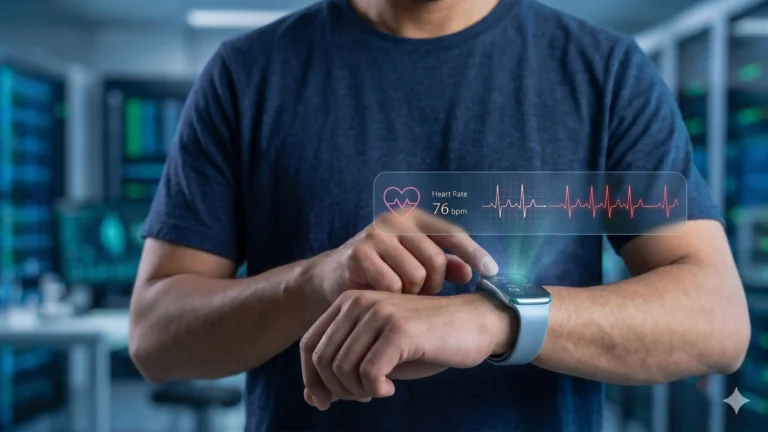
You’re possibly wearing a device right now that’s monitoring your heart every second. Most people have no idea what that data means, whether it’s accurate, or what to do with it. Your smartwatch can catch problems you’d never feel coming. But there’s a gap between what your device detects and what your doctor will actually act on. That gap is the whole point of this hub.

Wearables, Data & Your Doctor:
Everything You Need to Know
From detecting silent Atrial Fibrillation to getting your cardiologist to actually look at your data — this is where we cover it all
-
New Kid on the Block: Huawei Watch Fit 5 Pro Smartwatch with ECG Feature
Launched in May 2026, the Huawei Watch Fit 5 Pro brings a surprisingly deep cardiac feature set – ECG, pulse wave arrhythmia analysis, arterial stiffness detection.
-
How to Show Your Smartwatch Heart Data to Your Doctor (And What to Say)
You’ve been wearing that watch for months, quietly collecting heart rate readings, irregular rhythm alerts, and ECG strips. But most patients never actually bring that data to their cardiologist
-
Silent AFib Wearable Detection: How to Use What’s Already on Your Wrist
Atrial fibrillation can be completely silent. No palpitations. No warning. And yet it raises your stroke risk fivefold.
This article covers why AFib is so dangerous precisely when you can’t feel it, which wearables actually detect it (most don’t), and five things you can do right now to catch it early. -
Apple Watch EKG: How Accurate Is It Really? (What Stanford Research Shows)
Can the Apple Watch really save your heart? Yes, but with a catch. Here is what works, what it’s missing, and what to give your doctor from the PDF report.



Common Questions About Heart Health and AI Wearables
What exactly happens during atrial fibrillation? Why is it so dangerous?
Your heart’s upper chambers are supposed to squeeze in a coordinated rhythm, pushing blood down into the lower chambers. In AFib, they don’t squeeze — they quiver. Blood doesn’t move properly, so it pools. Pools → clots. Clots → stroke. The worst part? Most people feel absolutely nothing. You can have AFib for months and think you’re completely fine.
If my watch detects an irregular heartbeat, should I go to the emergency room?
Not automatically, no. A single alert isn’t a cardiac emergency — irregular beats happen to healthy people too. What matters is whether it’s repeating, how long it lasted, and whether you felt anything (dizziness, chest pressure, shortness of breath). One alert, no symptoms, feeling fine? Call your doctor this week. Multiple alerts plus symptoms? Don’t wait.
Why won’t my doctor look at my wearable data?
A few reasons. They weren’t trained on consumer wearable data. They’re skeptical of accuracy — sometimes rightly. And they’re seeing 20–40 patients a day, so there’s no time to parse 500 pages of heart rate logs. The fix isn’t to give up. It’s to show up with a clear summary of the pattern you noticed, not the raw data download. We have a whole guide on exactly this.
Can a smartwatch predict a heart attack?
No. Not with any certainty, anyway. Some watches can flag patterns — a sustained elevated heart rate, irregular rhythms, dropping oxygen saturation — that might mean something. But flagging a warning sign isn’t predicting a heart attack. Think of your watch as an early warning system, not a crystal ball.
Which wearable is best for heart health?
Depends what you’re optimizing for. Apple Watch has the most clinical research behind it and cardiologists actually recognize it. Garmin wins on battery life and tracking depth. Oura Ring is the one if sleep and HRV are your focus. Fitbit if you want solid basics without spending $400. But honestly? The best device is the one you’ll actually wear every single day.
What’s the difference between a wellness device and a medical device?
Wellness devices — most smartwatches — are built for tracking trends, not diagnosis. A medical device has been tested and cleared by regulators. Your doctor can legally use it to make treatment decisions. Big difference. Your Apple Watch is a wellness device. But here’s where it gets complicated: some features on consumer watches are FDA-cleared. Apple Watch’s AFib detection, for example. So it’s not a clean line. Parts of your watch are effectively “medical.” Most of it isn’t.
Is my heart data being sold to insurance companies?
The short answer: it depends heavily on where you live.
In regions with strong data protection laws — the EU’s GDPR being the clearest example — health data is classified as “sensitive personal data” with strict restrictions on how it can be collected, shared, or monetised. Insurers can’t simply buy it. Device manufacturers operating in those markets are legally bound to handle it carefully.
In other countries, the picture is murkier. Some jurisdictions have no specific legislation protecting health data generated by consumer wearables. What your smartwatch collects may not qualify as “medical data” under local law — which means it could potentially be shared, sold, or used in ways you wouldn’t expect. The US is a telling example: HIPAA protects data held by healthcare providers, but it doesn’t cover data collected by your Apple Watch or Fitbit. That sits in a legal grey area.
Wherever you are, the real risk isn’t usually the device manufacturer. It’s the ecosystem around them. Connected health apps, employer wellness schemes, and insurance products that offer premium discounts in exchange for fitness tracking — those are where your data is most likely to travel further than you’d want.
Before connecting any third-party app to your wearable, read its privacy policy. Before joining any wellness programme tied to your employer or insurer, understand exactly what you’re agreeing to. The incentive is rarely worth the trade-off.
Other Health Focus Areas You Might Find Helpful
Longevity & Early Detection → Learn how AI tools can help you catch health issues before they become serious — not just for heart health, but across your entire health picture.
Being Your Own Health Advocate → Beyond heart data: how to use AI tools to prepare for doctor visits, ask better questions, and take real control of your care.
A Note on Medical Information
This content is for informational and educational purposes only and does not constitute medical advice. If you have concerns about your heart health, irregular heartbeats, or any chest symptoms, please consult with a qualified healthcare provider. Wearable devices can provide helpful information for discussions with your doctor, but they should never replace professional medical evaluation or diagnosis.