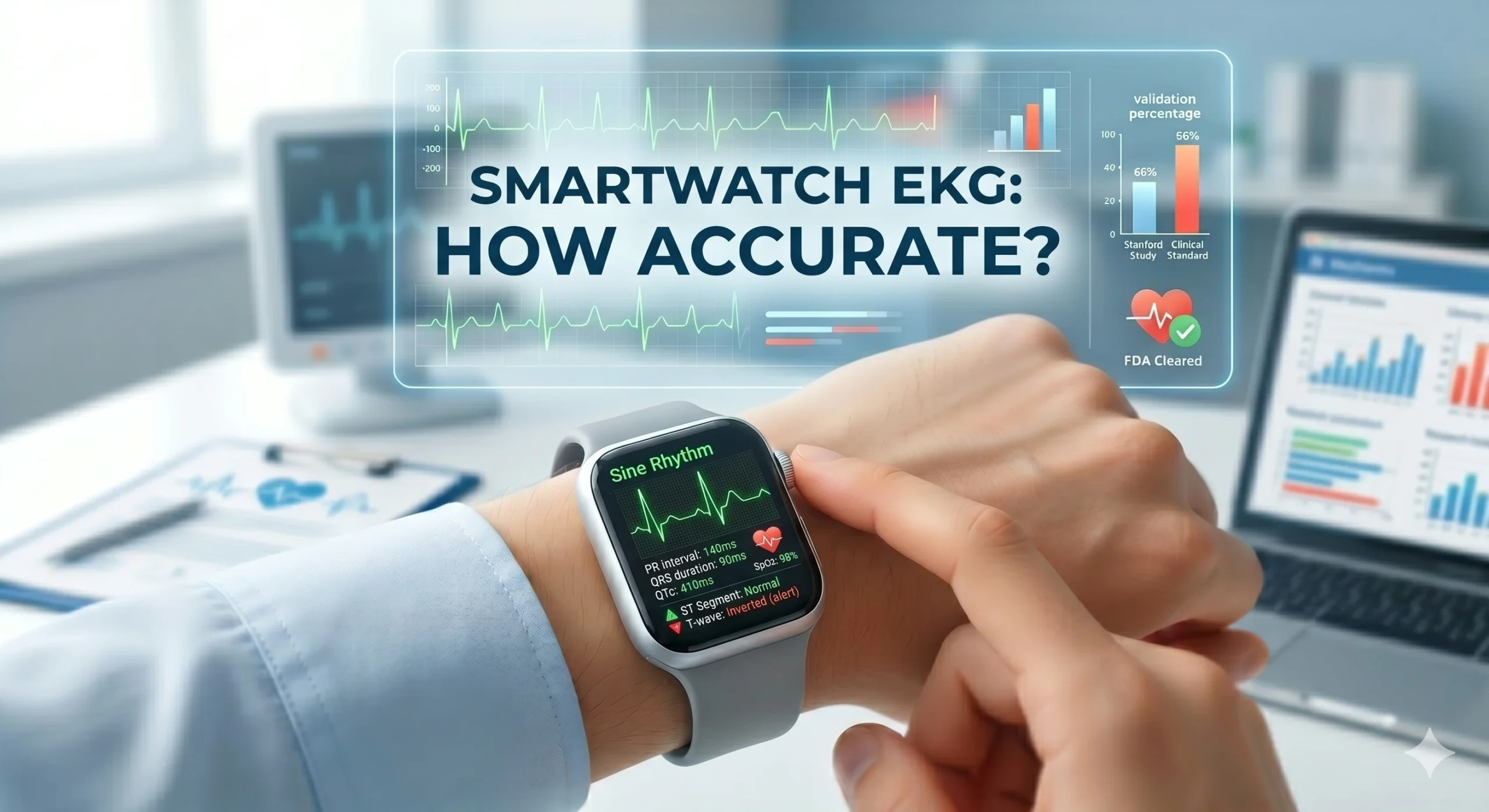
Apple Watch EKG: How Accurate Is It Really? (What Stanford Research Shows)
Got an “irregular rhythm detected” alert on your Apple Watch? Here’s what it actually means.
If you wear an Apple Watch, you’ve probably noticed that little heart icon. Maybe it flagged something. If so, you felt worry: Is my watch right? Should I call my doctor? How accurate is this thing?
The short answer: surprisingly good — but not perfect.
Here’s what the latest Stanford research actually shows, and what your cardiologist really thinks about it.
The Stanford Study: What Actually Happened
In early 2026, Stanford Medicine researchers presented findings at the Heart Rhythm Society conference: Apple Watch is now a legitimate clinical tool for detecting atrial fibrillation (AFib).1
Key finding: 86% accuracy when the watch detects an irregular rhythm.1
Why does this matter? Because cardiologists are starting to trust it. That wasn’t true five years ago.
What this means:
- If your watch alerts you to AFib → likely correct (86% of the time)
- If your watch says normal → probably fine (but not 100% guaranteed)
How Your Apple Watch Actually Checks Your Heart
The watch uses two sensors working together:
Passive monitoring (PPG sensor) The optical sensor on the back watches your pulse continuously. It’s looking for irregular patterns that suggest AFib. When detected, it sends a notification.
Active confirmation (EKG app) The watch asks you to hold your finger on the digital crown for 30 seconds. This records a single-lead ECG — the same measurement doctors use, just from one angle instead of 12.
Result: Two-step confirmation = higher accuracy than relying on just one method.
False Positives vs. False Negatives: What You Need to Know
Good news: The Apple Watch has a very low false positive rate.12 If it tells you something is wrong, it’s usually right.
The catch: Your watch might miss an irregular rhythm. It needs at least 2 minutes of irregular heartbeat before it alerts you.3 Short bursts of AFib? The watch could miss them.
In plain terms: A normal reading is reassuring, but it’s not a guarantee you don’t have AFib.
What Your Cardiologist Actually Thinks About Watch Data Now
Here’s what changed: Cardiologists now take Apple Watch data seriously.
If you show up with an AFib alert from your watch, your doctor will:
- Review your saved EKG reading
- Decide if additional testing is needed (EKG, Holter monitor)
- Consider it in your overall heart assessment
This is a big shift. Five years ago? Many doctors dismissed wearables. Now? No rules ban clinicians from using patient-reported Apple Watch data.3
Bottom line: Your watch isn’t a final diagnosis—it’s a starting point for a real medical evaluation.
The Accuracy Numbers, Explained Simply
Let’s break down what “86% accurate” actually means:
- If the watch says you have AFib: there’s an 86% chance you actually do
- If the watch says everything is normal: you probably are normal, but there’s a small chance you could still have AFib that the watch missed
Different studies have shown slightly different numbers depending on the population tested, but they all point in the same direction: the watch is pretty good at catching AFib when it’s happening.
One study from Cleveland Clinic found that when they used the watch’s full EKG recording (not just the display), it caught 98% of AFib cases in their test group.2 So the accuracy depends partly on how you use the watch and whether you bother to record the EKG when it asks.
What This Means for You: Action Steps
If You Get an AFib Alert
- Record the EKG when the watch asks (boosts accuracy to 98%)2
- Call your doctor — mention the alert and time it occurred
- Bring the saved reading to your appointment
- Expect follow-up testing (EKG or Holter monitor) to confirm
If Your Watch Shows Normal Readings
- Good sign, but not a 100% guarantee
- Still report chest palpitations or shortness of breath to your doctor
- Don’t assume “normal on watch = definitely healthy”
Bottom line: Your Apple Watch is an early warning system. Useful, but not the final say.
The Insider Take: Why Apple Calls It “Wellness” Not “Medical”
Here’s something most people don’t realize: Apple doesn’t call the EKG reading a “medical device” in the marketing — they call it “wellness.” Why?
Because there’s a difference between:
- A medical-grade EKG: done in a hospital or clinic, interpreted by a cardiologist, legally actionable for diagnosis
- A wellness EKG: done on your watch, useful information, but not a formal diagnosis
This distinction matters legally and clinically. Apple is protecting itself by being careful about the language. Your watch can alert you to a potential problem, but it can’t diagnose you. Only a doctor can do that.
That said, the Stanford research shows the watch is getting so accurate that cardiologists are treating the data more like actual clinical information every year.
Looking Forward: It’s Getting Better
The research from 2025-2026 shows a trend: Apple Watch AFib detection is improving. The sensors are getting better, the algorithms are getting smarter, and clinicians are getting more comfortable using the data.
If you’re someone with heart health concerns, or if you’re in that 45-65+ age group where AFib becomes more common, having an Apple Watch that monitors your heart is genuinely useful. Just remember: it’s a tool that supplements your doctor’s care, not a replacement for it.
Key Takeaways
- The Apple Watch can detect AFib with 86% accuracy according to the latest Stanford research
- It works best when you actually record the EKG reading when it asks
- If your watch alerts you, take it seriously but see a doctor to confirm
- If your watch shows normal, that’s usually good — but palpitations should still be checked out
- Your doctor will likely trust the data now more than they would have 5 years ago
Your Apple Watch isn’t a magic health detector, but it’s not hype either. It’s a legitimate tool that’s catching real cases of AFib in people who might not have known anything was wrong. And for a condition like AFib that increases stroke risk, catching it early matters.
Have you gotten an AFib alert on your Apple Watch? Or are you considering getting one because of heart health concerns? Share your experience in the comments — hearing from real patients helps others understand what to expect.
References & Sources:
FAQ: Apple Watch EKG Accuracy
Q: Is Apple Watch EKG 100% accurate?
A: No. Latest research shows 86% accuracy for AFib detection.1 It’s reliable but not perfect — false positives are rare, but false negatives (missed AFib) can happen.
Q: What should I do if my watch detects irregular rhythm?
A: Record the EKG reading, contact your doctor with the alert details, and bring the saved data to your appointment.
Q: Can my doctor use Apple Watch EKG data?
A: Yes. There are no current rules banning clinicians from using patient-reported wearable data in medical decisions.3
Q: What’s the difference between “wellness” and “medical” EKG?
A: Wellness EKG (Apple Watch) is helpful information but not an official diagnosis. Medical-grade EKGs are done by healthcare providers and are clinically diagnostic.
Q: If my watch says normal, am I definitely healthy?
A: Probably, but not guaranteed. The watch needs at least 2 minutes of irregular rhythm to detect it.3 Report any palpitations to your doctor regardless.
Disclaimer: This article is for informational purposes only and is not a substitute for professional medical advice. Always consult with your cardiologist or healthcare provider about any heart health concerns, symptoms, or questions about using wearable devices in your care plan.
Footnotes
The AFib Clinic. “Apple Watch and AFib: Accuracy, Features, and Tips.” https://drafib.com/blog/apple-watch-and-afib/ — Cardiologist-reviewed clinical guidance on how doctors evaluate Apple Watch EKG data. Details on Kardia Mobile alternatives and clinical decision-making with wearable data. 2 3 4
Perez, M. et al. (2026). “What Role Do Apple Watches & Wearables Play in Detecting Cardiovascular Concerns?” Heart Rhythm Society Conference 2026. See: https://www.mddionline.com/cardiovascular/what-role-do-apple-watches-wearables-play-in-detecting-cardiovascular-concerns- — Reports 86% accuracy for Apple Watch AFib detection and details on clinical validation. 2 3 4
Cleveland Clinic. “Cleveland Clinic Studies Accuracy of Apple Watch for Atrial Fibrillation Detection.” Cleveland Clinic Newsroom. https://newsroom.clevelandclinic.org/2020/02/25/cleveland-clinic-studies-accuracy-of-apple-watch-4-for-atrial-fibrillation-detection — Documents 96-98% accuracy with full EKG recording data vs. 41% with display alone. Led by Dr. Marc Gillinov, MD. 2 3